Red Sea: Submerged Treasures Reveal Saudi Arabia’s Civilizational Heritage
The depths of the Red Sea hold a wealth of cultural and heritage evidence, including the remains of shipwrecks and archaeological artifacts that have lain underwater for hundreds of years. They stand as testimony to ancient maritime trade routes, the movement of travelers and pilgrims, and the enduring interaction among civilizations that crossed the region. The Red Sea has historically served as an important maritime corridor linking the Arabian Peninsula with parts of Asia, Africa, and the Mediterranean.
Submerged cultural heritage is defined as evidence of human presence of a cultural, historical, or archaeological nature that has remained fully or partially submerged underwater for at least 100 years. It includes shipwrecks and their contents, sites, structures, archaeological finds, and other evidence associated with human activity.
Saudi Arabia has placed significant emphasis on protecting and documenting this heritage. The Kingdom joined the 2001 UNESCO Convention on the Protection of the Underwater Cultural Heritage and deposited its instrument of ratification in 2015, reaffirming the importance of preserving this component of cultural heritage for future generations.
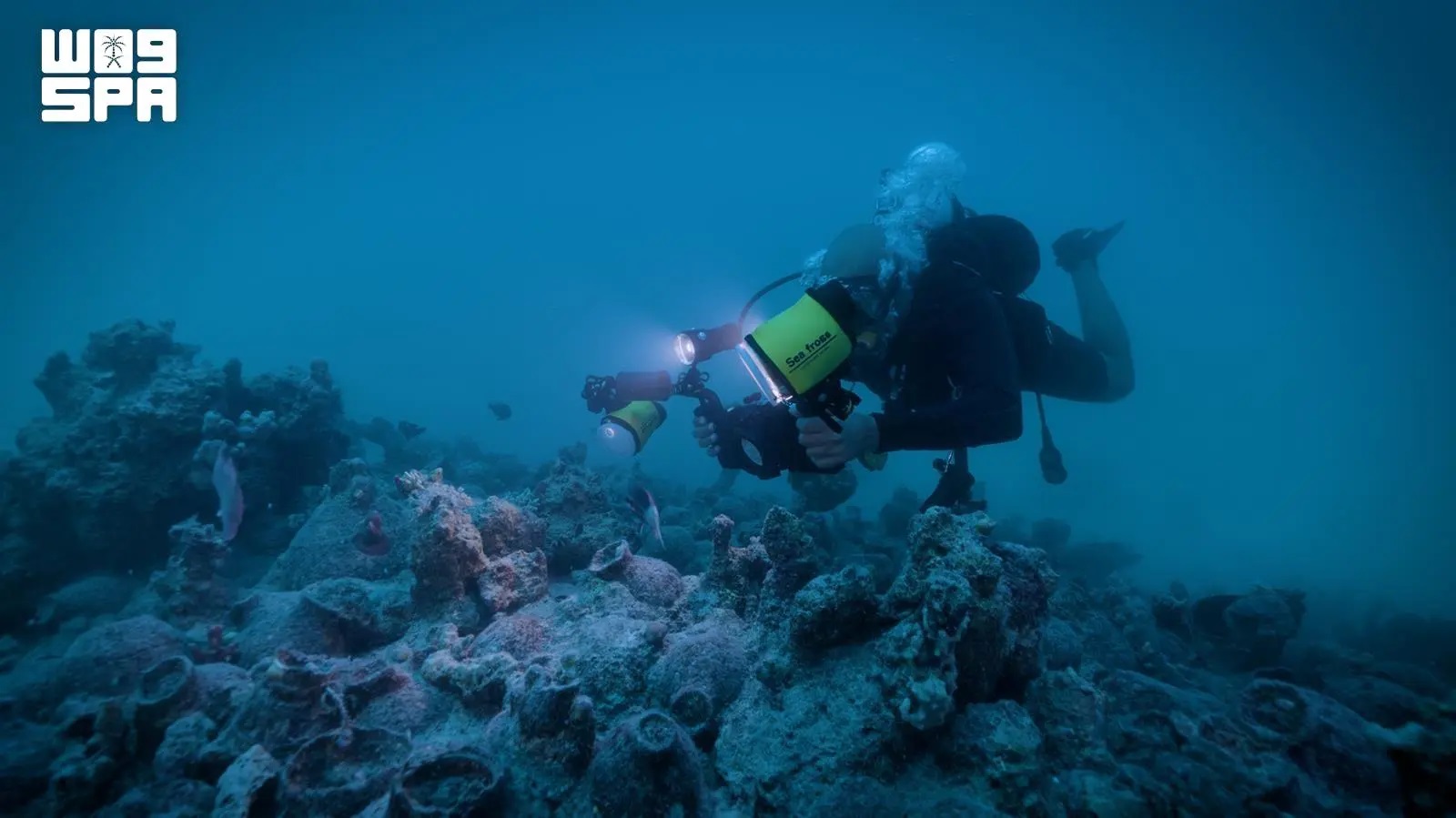
Over the past decades, Saudi Arabia’s coasts have witnessed a number of underwater archaeological surveys and research activities. In 2012, joint archaeological surveys began along the coast between Rabigh and Al-Shuaiba, in cooperation between Saudi Arabia’s then archaeological authority and Germany’s Philipps-Universität Marburg. The work continued in subsequent seasons and contributed to the discovery of shipwreck remains dating to different historical periods, including one associated with the Roman period and another dating to the early Islamic period.
In 2015 and 2016, joint archaeological surveys were conducted with an Italian team from the University of Naples “L’Orientale” at the site of the Al-Wajh shipwreck. The Heritage Commission later continued developing underwater cultural heritage survey activities. Notably, a 2022 project surveyed the area between Umluj and Ras Al-Sheikh Hamid in cooperation with local and international scientific institutions. The project covered an area of up to 400 square kilometers and identified and documented more than 25 sites along its route.
The Umluj shipwreck exemplifies the details that maritime archaeological studies can reveal after remaining preserved underwater for centuries. The sites identified through surveys along the Saudi coast further underscore the vast research potential of underwater cultural heritage.
Documentation and study mark the beginning of an integrated process of protection and preservation. The Heritage Commission is responsible for surveying, documenting, studying, and protecting underwater cultural heritage sites in cooperation with universities, scientific centers, and specialized local and international entities.
The commission’s efforts have included maritime survey projects in the Red Sea and the documentation of submerged archaeological sites, contributing to a more comprehensive understanding and preservation of Saudi Arabia’s maritime heritage. These efforts also seek to raise awareness of the value of this heritage and publicize archaeological findings and discoveries. They further enhance recognition of submerged sites as an integral part of the national cultural heritage and as a record of Saudi Arabia’s history and its civilizational links across the Red Sea.