RCU Campaign Reveals Details of Over 19,000 Rock Art Panels in AlUla
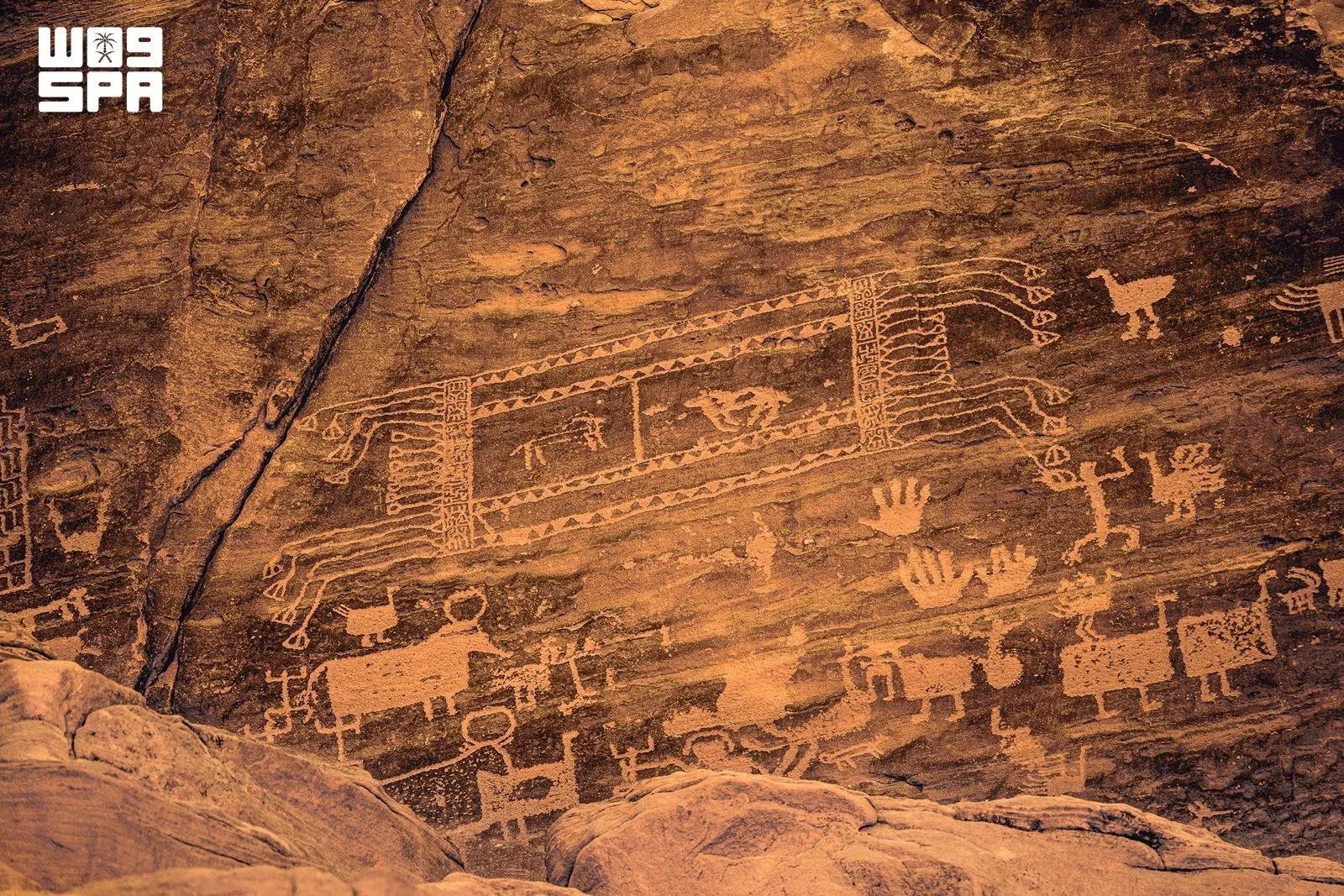
The Royal Commission for AlUla (RCU) has launched an awareness campaign across its social media platforms highlighting findings from archaeological studies and surveys. Running through the end of the year, the campaign showcases approximately 19,802 documented panels featuring more than 66,000 animal figures and over 11,000 human figures.
The panels represent a human record spanning more than 12,000 years, documenting aspects of daily life, societal transformations, and the relationship between humans, animals, and their surrounding environment. Together, they form the largest indexed regional database of rock art in the Arabian Peninsula.
The campaign highlights scientific methods and collaborative efforts by archaeologists and the local community in AlUla to date the carvings and distinguish between the oldest and most recent examples. The process includes on-foot site surveys, photography, sketching, and descriptions, as well as precise recording of their coordinates.
Researchers also examine the superimposition of images, execution techniques, depicted subjects, and associated inscriptions. In addition, they analyze a dark layer that gradually forms on the rock surface, known as rock patina, to help determine the relative age of the carvings.
The campaign covers 10 key themes: rock art as a historical record; evidence of the transition from hunting to herding; environmental and climatic shifts; AlUla as a hub for trade and communication; archaeological survey and documentation efforts; vehicles as symbols of status and influence; locally extinct animals; oasis sustainability and herd ownership; horsemanship, conflict, and survival; and the continuity of this form of expression.
The carvings reveal the role of water in sustaining pastoralism and shed light on the significance of geometric patterns. As aridity increased in surrounding regions, AlUla Valley remained a sanctuary offering water, oases, and vegetation. The images also demonstrate the continued presence of cattle in the area during the Iron Age and pre-Islamic period, when such depictions had become extremely rare at other sites in northern Saudi Arabia. They have also enabled researchers to interpret characteristics of the Holocene, roughly 8000–4000 BCE, when grasslands and lakes were widespread across parts of the northern Arabian Peninsula.
Other scenes depict battles and human efforts to defend against predators, both for self-protection and to safeguard herds. They reveal aspects of horsemanship, warfare, and the struggle for survival. Archaeological surveys have documented 14,670 images of horses and riders and 1,375 battle scenes. In addition, 180 scenes of conflicts with carnivores have been recorded, showing lions, tigers, leopards, and hyenas attacking humans or livestock, as well as people protecting their herds and hunting predators.
Caravans traced their paths across the rocks of AlUla long before trade routes were marked on maps. Images believed to represent camel caravans, horses, riders, litters, and chariots appear alongside scenes of travel and combat, reflecting AlUla's role as a crossroads and hub for communication among communities.
With abundant water and flourishing oases, AlUla became a vital stop along regional trade networks, connecting ancient urban centers such as Dadan, Hegra, Qurh, and Umm Hadam. The enduring traces of these routes and travelers attest to AlUla's historical significance.
The high concentration of chariot depictions highlights their social and cultural significance and provides enduring evidence of the status and influence of their owners thousands of years ago. Archaeological surveys have documented 38 images of horse-drawn chariots, 25 of which were found in Wadi Al-Naam, a site that may represent one of the largest concentrations of such carvings in the Arabian Peninsula. These chariots were likely not suited for long-distance travel and may instead have been used within the oases and associated with individuals of high status.
Archaeological surveys have also documented 395 depictions of motor vehicles, reflecting the enduring use of rock surfaces as a medium for expression and a record of the tools of each era. The rocks of AlUla thus remain an open record of life's transformations, preserved over time.