Saudi Arabia Achieves Historic Milestone with Launch of 'Shams' Satellite Aboard Artemis II Mission
The Saudi Space Agency announced today the successful launch and initial communication with the Saudi satellite “Shams,” which was deployed aboard the Space Launch System (SLS) as part of the Artemis II mission. With this achievement, the Kingdom becomes the first Arab nation to participate in a space mission under the historic Artemis program, which aims to accelerate scientific innovation and foster high-impact international partnerships that contribute to shaping the future of space for humanity.
Artemis II represents the second phase of the Artemis program, led by the National Aeronautics and Space Administration (NASA) in collaboration with international partners. The mission aims to return humans to the vicinity of the Moon for the first time in more than five decades, paving the way for future missions to Mars. It carries a crew of four astronauts on the first crewed lunar flyby mission aboard the Orion spacecraft, powered by the Space Launch System (SLS), the most powerful launch vehicle ever developed. The mission also carries the Saudi satellite “Shams” as part of its scientific payload.
The “Shams” satellite will operate in a highly elliptical orbit (HEO), ranging from approximately 500 km to 70,000 km above Earth. This orbit enables broad coverage for monitoring solar and radiation activity, enhancing space weather research, providing an advanced scientific environment, and supporting critical applications associated with it.
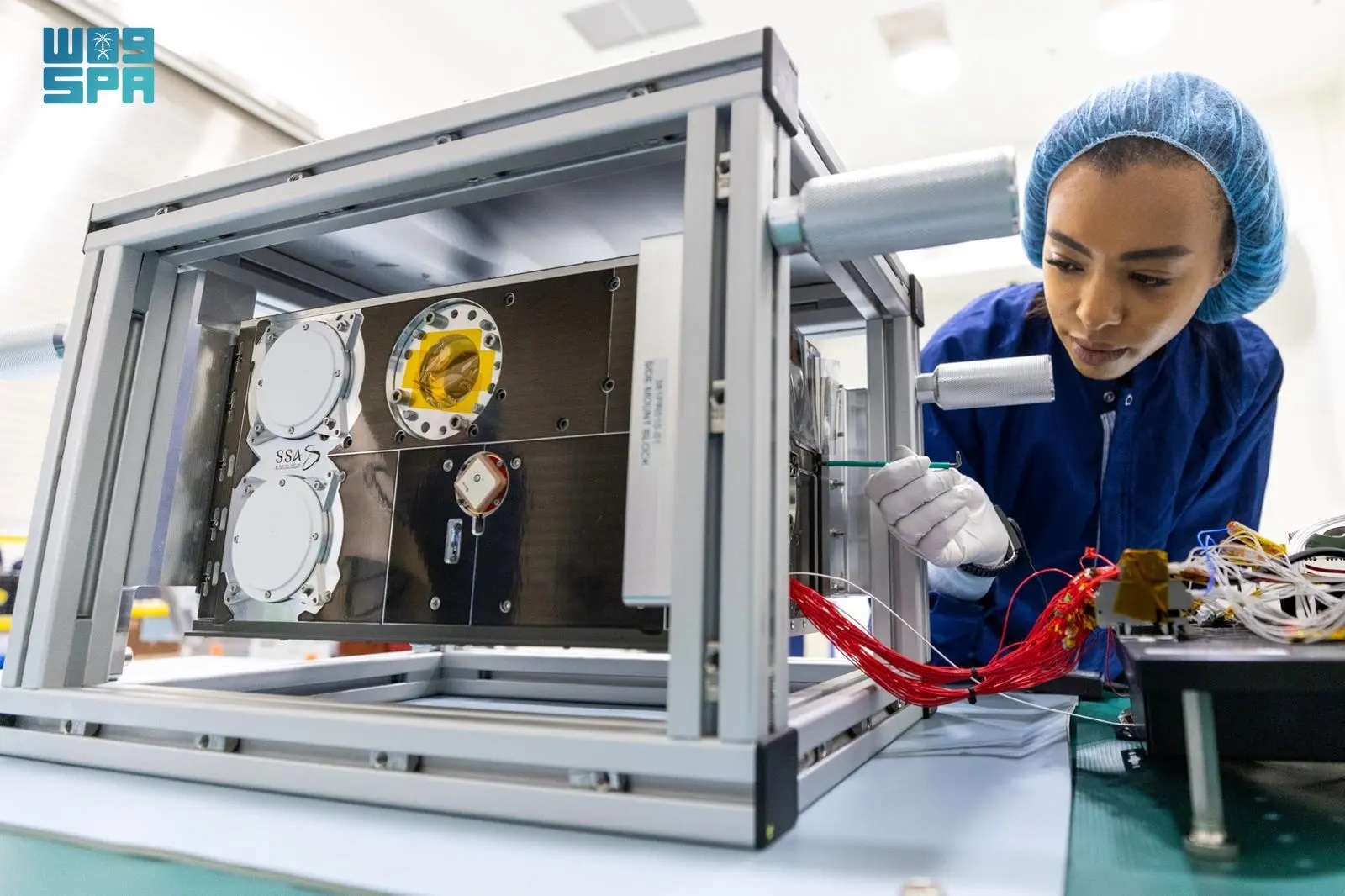
“Shams” represents a multi-first achievement. It is the first Arab mission launched as part of the Artemis program and the first national mission dedicated to space weather monitoring, underscoring the Kingdom’s progress in advanced space technologies. The satellite was developed domestically by Saudi talent, supported by initiatives under the National Industrial Development and Logistics Program (NIDLP), one of the key enablers of Saudi Vision 2030.
The mission aims to study space weather and monitor the effects of solar and radiation activity on Earth through four main scientific domains: space radiation, solar X-rays, Earth’s magnetic field, and high-energy solar particles.
This scientific mission contributes to enhancing the reliability and sustainability of critical sectors linked to space, such as communications, aviation, and navigation, by providing data that supports operational readiness and strengthens the security of the technical infrastructure relied upon globally in daily life.
Acting CEO of the Saudi Space Agency Dr. Mohammed bin Saud Al-Tamimi stated, “This achievement is the result of the unwavering support received by the space sector from the Custodian of the Two Holy Mosques King Salman bin Abdulaziz Al Saud, and His Royal Highness Prince Mohammed bin Salman bin Abdulaziz Al Saud, Crown Prince and Prime Minister, whose vision has empowered national talents and enhanced their capabilities to participate in leading global space missions. This milestone reflects the Kingdom’s scientific and technological advancement under Vision 2030 and underscores its active role in developing advanced technologies and shaping the future of space for humanity.”
For his part, CEO of the National Industrial Development and Logistics Program (NIDLP) Eng. Jameel bin Ahmed Al-Ghamdi stated that developing the “Shams” satellite within the Kingdom reflects the impact of the program’s initiatives in localizing advanced technologies and building competitive national industrial capabilities. He emphasized that this achievement demonstrates the integration of national efforts in empowering talent and strengthening local content, in line with the objectives of Saudi Vision 2030.
The Saudi Space Agency affirmed that this achievement embodies the Kingdom’s vision to promote innovation, develop national capabilities, and build high-value international partnerships, further reinforcing its role in shaping the future of space exploration.