From Saudi Arabia’s Jeddah Central Project to China’s Xiong’an: Why the ‘cities of the future’ require skyward vision and earthbound roots
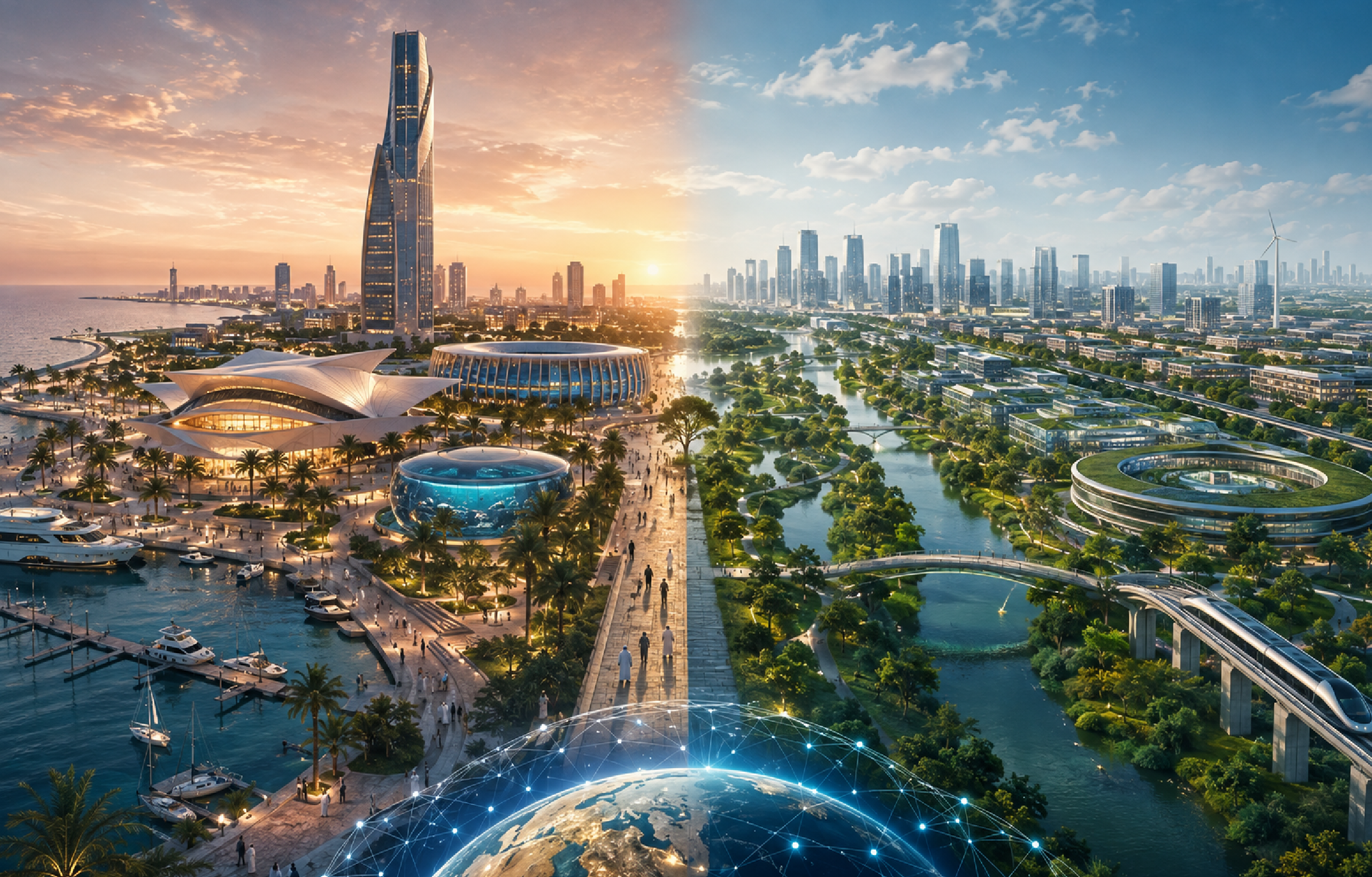
What will tomorrow’s cities look like? Glowing waterways, sleek transit pods gliding on neon tracks, and a digital utopia of glossy, frictionless perfection – just ask any AI to paint the future, and this is probably how you get sold the dream.
However, turning such imagination into the reality of an actual “city of the future” is far more complex. The grander the skyward vision, the more it depends on solid engineering, sustained investment, and robust governance to bring those ambitions to life. This is the universal challenge facing every bold urban experiment, whether it rises from the coast or fertile plains. Today, the Jeddah Central Project on the shores of Saudi Arabia's Red Sea and the Xiong’an New Area on the North China Plain, while born from different national contexts, offer two distinct answers to the very same question.
Look toward Jeddah’s historic western coast, where centuries of maritime tradition meet modern ambition. Backed by the country’s Vision 2030, this multi-billion-dollar urban reboot aims to turn a core city district into a global magnet for tourism, culture, and investment, fundamentally reshaping how the city grows. Pouring massive capital into reinventing an existing urban core into a world-class hub is a bold statement on how to approach modern urban renewal.
At the heart of this ambition are four landmark cultural additions – an opera house, a museum, a sports stadium, and an oceanarium – backed by a 9.5-kilometer waterfront, a shiny new marina, and residential spaces that mix smart tech with traditional Hijazi design. Together, they aim to weave the Kingdom's deep-rooted maritime heritage into the fabric of a buzzing modern destination, creating a vibrant space where past and future seamlessly meet.
Bringing an audacious vision of this scale into the physical world naturally involves a process of dynamic refinement. Rather than chasing a vague blueprint, the Jeddah Central Project is structured around a three-phase rollout, with the first phase locked in for completion soon, according to media reports. Backed by billions of Saudi riyals in initial construction contracts signed with major international and local contractors, the work on the ground is methodically moving forward: heavy infrastructure, smart utility networks, and marine engineering are steadily taking shape, breathing practical life into the city's core.
Thousands of miles away on the North China Plain, Xiong’an New Area is also pursuing an inspiring trajectory. Rather than chasing immediate skylines, Xiong’an has spent years perfecting what lies unseen: an integrated network of underground utility tunnels and a digital twin model of the entire city.
This long-term focus extends to its environment. Long before the heavy density of urban life arrived, China prioritized the restoration of the Baiyangdian Lake, anchoring the new city in green space and ecological resilience rather than concrete alone. It reflects the belief that resilient cities are built from the ground up – both physically and institutionally.
Today, that methodical groundwork, rooted in “a plan designed for the millennium,” is yielding concrete results. The area has gradually become home to more than 1.4 million residents, while more than 400 subsidiaries of state-owned enterprises and 4,000 Beijing-based firms have moved their operations there, transforming a national policy into an emerging economic hub. These milestones are the result of years of unglamorous, day-to-day cultivation – laying deep roots before ever reaching skyward.
Side by side, the two megaprojects reveal two different philosophies for building “the cities of the future.” The Jeddah Central Project chose the path of brownfield renewal – breathing new life into an existing urban core with an ambitious vision backed by a step-by-step rollout. Xiong’an, meanwhile, breaks the usual mold of massive greenfield development that focuses on chasing quick-win skylines and rapid commercial returns, emphasizing foundational infrastructure and long-term urban planning from the outset.
Neither path offers an easy shortcut, for both demand extraordinary capital, engineering precision, and sustained political willpower. Nor is either complete: Jeddah’s ambitious urban reboot still has to navigate the intricate realities of heritage preservation and long-term capital sustainability, while Xiong’an’s industrial clusters and population are still scaling up.
Ultimately, they highlight distinct dimensions of national capability. Saudi Arabia demonstrates how capital and ambition can open new frontiers, while China illustrates how long-term planning and industrial capacity can gradually transform visions into reality. Far from competing paradigms, their respective approaches – one boldly reaching skyward with visionary ambition, the other patiently laying deep roots through foundational execution – present fertile ground for mutual learning.
As emerging technologies redefine society, building the cities of tomorrow remains an exercise in patience. No amount of glowing digital art can dispense with the unglamorous groundwork of institutional coordination, just as no amount of infrastructure can substitute for the bold, pioneering spirit that revitalizes urban life and redefines historic centers. That is perhaps the deepest lesson shared by both the Jeddah Central Project and Xiong'an: The future belongs only to those who possess both the vision to reach skyward and the patience to lay deep roots.
The author is a reporter with the Global Times. xiawenxin@globaltimes.com.cn